Our mission is to guide you through the less traveled paths, uncovering the beauty and mystery of secluded spots. Whether you’re an avid adventurer seeking your next thrill, a culture enthusiast eager to discover untold stories, or someone looking to escape the hustle and bustle of popular tourist destinations, you’ve come to the right place.


About Us
Off-The-Map.org was founded by a group of passionate explorers who believe that the most memorable experiences lie off the beaten path. We are adventurers, storytellers, and conservationists at heart, dedicated to sharing the world’s hidden wonders while promoting sustainable travel practices. Our team is composed of seasoned travelers, local experts, and environmental advocates, all united by a love for discovery and a commitment to preserving the beauty of our planet.
What We Offer
Unique Destinations
Dive into our curated selection of unique destinations that are off the typical tourist radar. From secluded beaches and hidden waterfalls to ancient ruins and untouched natural reserves, our extensive database is a treasure trove of places waiting to be explored.
Travel Guides & Tips
Our comprehensive travel guides and tips are designed to equip you with all the information you need to embark on your off-the-map adventure. Learn about local customs, find out the best times to visit, get packing advice, and discover how to travel responsibly.
Adventure Tours
Join one of our exclusive adventure tours to experience off-the-map destinations with the guidance of our expert leaders. Our tours are carefully crafted to offer an immersive experience, focusing on small groups and sustainable practices to minimize our footprint.
Community Stories
Be inspired by stories from fellow travelers in our community. Read about their adventures, learn from their experiences, and get motivated to create your own off-the-map journey. Share your story with us and become part of a growing community of explorers.
Interesting Articles
-
Open Questions and Reflective Listening: A Guide to a More Useful Conversation

When someone describes a difficult week, it is easy to answer with a solution before understanding the problem. A different approach starts with a question and a brief reflection of what the person said. This does not require playing therapist or pretending to know how they feel. It means checking your understanding before deciding what kind of response would be useful.
Ask what kind of conversation is wanted
A person may want practical help, room to think aloud or simply company. Those are different requests. A short opening such as “Would you like me to listen, help think through options, or do something practical?” gives the other person a choice without requiring a detailed explanation immediately.
The question is not a contract that can never change. Someone may begin by wanting to talk and later ask for help with a concrete task. Keep checking the direction naturally. The purpose is to avoid assuming that your preferred way of helping is automatically the kind of help being requested.
Use an open question for an open subject
An open question invites more than a yes-or-no answer. “What part of the week was most difficult?” leaves room for the person’s own priorities. “Was your manager the problem?” introduces your explanation before they have supplied theirs. Both are grammatically questions, but they create different space for an answer.
The National Institute on Drug Abuse hosts an introduction to open questions, affirmation, reflection and summaries used in motivational interviewing. These are professional communication skills in that context. Borrowing a simple listening technique for everyday life does not make an ordinary conversation a clinical intervention.
A reflection checks meaning
A reflection briefly restates what you understood. If someone says that a plan keeps changing, a response might be “The uncertainty is wearing you down.” That is a tentative interpretation of the message, not a diagnosis. Leave room for correction: the person may explain that the workload, rather than uncertainty, is what bothers them.
Use their correction as useful information. A reflection has done its job if it helps clarify the meaning, even when the first attempt was incomplete. Avoid arguing that your interpretation must be right because you were trying to be empathetic. The speaker remains the authority on what they intended to convey.
Reflection is not agreement with every conclusion
You can acknowledge that an experience was upsetting without endorsing every accusation or proposed action. “You felt ignored in that meeting” describes an experience. “Everyone there is against you” adds a sweeping claim that may not be justified. Keeping the reflection close to what was said supports understanding without inventing certainty.
The Veterans Affairs discussion of communication and social connection emphasizes listening, inquiry and avoiding imposed conclusions. That approach is useful across ordinary differences of opinion. Understanding another person’s perspective does not require surrendering your own judgment or pretending an unresolved disagreement has disappeared.
Leave enough space for an answer
Several questions in a row can feel like a test. Ask one, then allow time for a response. A brief pause may mean the person is choosing words, not that you need to fill the silence. If the setting is noisy or rushed, acknowledge that limitation rather than demanding an important conversation on unsuitable terms.
Attention can be shown in different ways. People vary in comfort with eye contact, physical distance and pauses. Do not treat one style of body language as a universal indicator of honesty or engagement. Ask about practical preferences when needed, and focus on whether the person has a reasonable opportunity to speak.
Offer advice with a clear invitation
If an idea occurs to you, ask whether it would be useful to hear it. Then present it as an option, including what you do not know. “Would it help to list the questions for tomorrow’s call?” is narrower than telling someone how to resolve a complicated relationship or health problem after hearing a few sentences.
Concrete help can be valuable: reviewing a timetable, making space for a break or helping locate an appropriate service. Keep promises proportionate to what you can provide. An offer that you can carry out is more useful than a dramatic reassurance that depends on circumstances beyond your control.
Compare three possible replies
Reply What it does “What changed after the meeting?” Invites the person to add information. “You were expecting a clear decision and left with more uncertainty.” Reflects an interpretation that can be corrected. “Would you like to draft a question for the next meeting?” Offers a specific practical next step. The examples are fictional and deliberately ordinary. They are not scripts that must be repeated word for word. Their value lies in distinguishing functions: asking, checking understanding and offering action. A conversation can move among those functions without turning into a formal exercise.
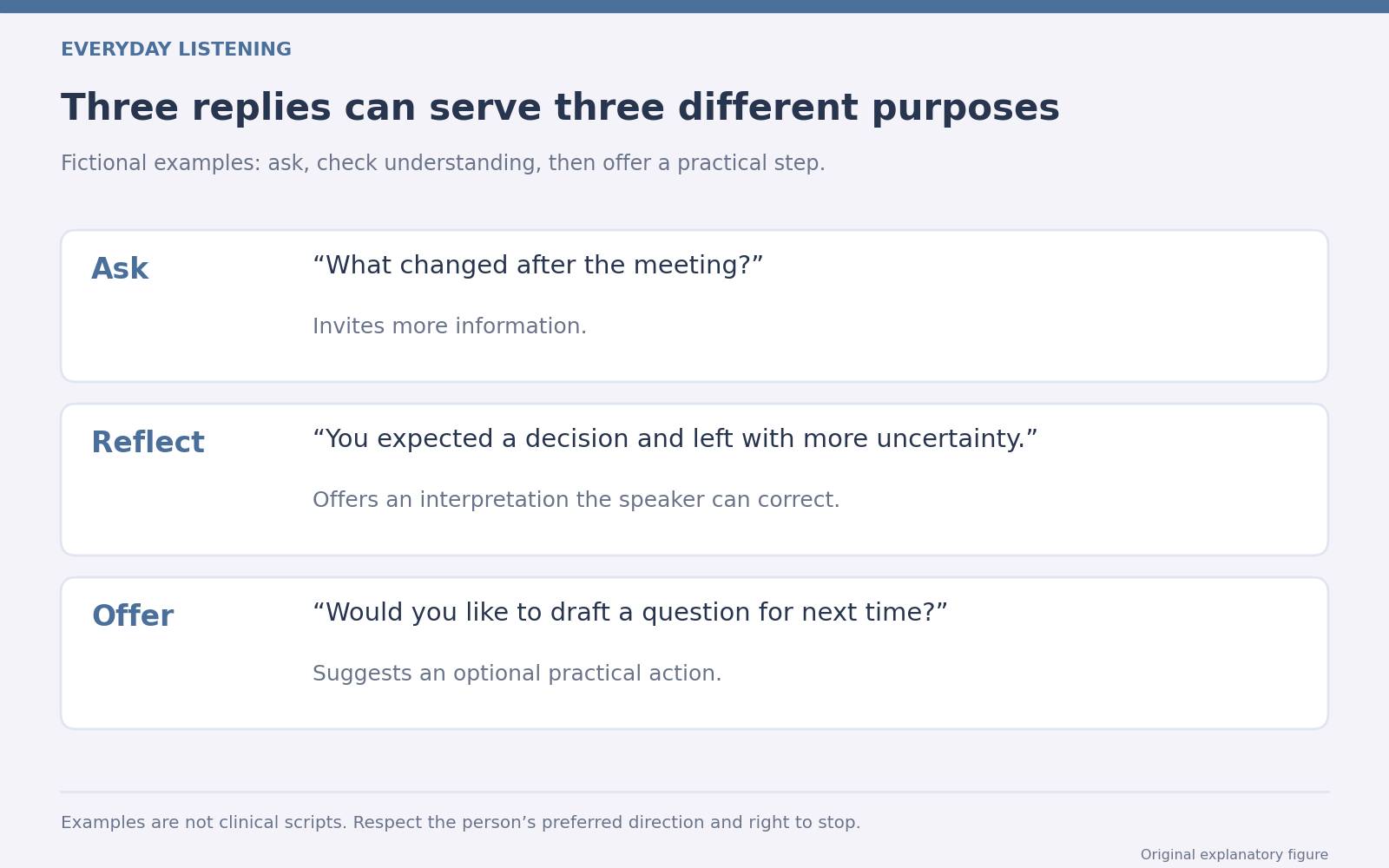
A reflection checks understanding and can be corrected. Offering help does not make the listener responsible for solving every problem. Image credits. Respect the right not to continue
Someone may decline to discuss a subject, choose a different listener or want to stop. Respect that choice. Curiosity is not permission to extract personal details. Do not promise secrecy that you cannot responsibly maintain, and do not turn private information into a story for a wider group.
Everyday support also has limits. If someone needs professional care, a friendly conversation is not a substitute. If there is immediate danger, seek urgent help appropriate to the situation. Recognizing those limits does not diminish the value of listening; it prevents an ordinary supportive role from becoming a claim of expertise.
End with a shared understanding
A short summary can check what was useful: what happened, what matters to the person, and whether any next step was agreed. Do not add a new action at the end as if it had already been accepted. If the outcome is simply that the person wanted to be heard, that can be a complete conversation.
This kind of attention connects social experience with questions about stress and wellbeing, but it does not prove that a particular conversation changed a hormone. The practical skill stands on its own. Biological explanations can be explored separately, with the same care about what was observed and what remains an interpretation.
-
Can Semaglutide Damage Your Pancreas?
Semaglutide, a medication commonly used to manage type 2 diabetes and support weight loss, has gained widespread attention—with semaglutide for sale online becoming increasingly accessible through digital pharmacies. Alongside its proven effectiveness in improving glycemic control and reducing body weight, the drug has also sparked discussions about its potential impact on pancreatic health. Some studies have raised concerns about elevated pancreatic enzyme levels and a possible link to pancreatitis. These findings have fueled ongoing debates among healthcare professionals and researchers aiming to fully understand the long-term safety profile of this promising treatment.
Understanding Semaglutide and Its Uses
Semaglutide, a glucagon-like peptide-1 (GLP-1) receptor agonist, has gained prominence as an effective medication for managing type 2 diabetes and obesity. By mimicking the action of the incretin hormone GLP-1, semaglutide enhances glucose-dependent insulin secretion, which is vital for diabetes management.
This mechanism helps lower blood sugar levels by promoting insulin release when glucose levels are elevated. Additionally, semaglutide slows gastric emptying, which contributes to reduced appetite and facilitates weight loss, offering dual benefits for individuals with type 2 diabetes who struggle with obesity. The semaglutide mechanism also involves inhibiting glucagon release, thereby reducing hepatic glucose production. These actions collectively aid in better glycemic control, offering a promising approach for individuals seeking extensive diabetes management solutions.
The Role of the Pancreas in the Body
The pancreas plays a pivotal role in maintaining the body’s metabolic balance, especially in the context of diabetes management where medications like semaglutide are utilized. This essential organ performs fundamental pancreatic functions that are critical for both digestion and glucose regulation. It produces digestive enzymes that break down carbohydrates, proteins, and fats, facilitating nutrient absorption. Additionally, the pancreas is responsible for the secretion of insulin and glucagon, hormones that regulate blood glucose levels.
Key pancreatic functions include:
- Production of insulin: Helps control blood sugar levels.
- Glucagon secretion: Increases blood glucose when necessary.
- Release of digestive enzymes: Aids in nutrient breakdown.
- Bicarbonate secretion: Neutralizes stomach acid entering the small intestine.
- Hormonal regulation: Balances digestive and metabolic processes.
Understanding these functions highlights the pancreas’s significance in overall health.
Research on Semaglutide and Pancreatic Health
Emerging research illuminates the potential impact of semaglutide on pancreatic health, particularly in the management of type 2 diabetes. Studies have shown that semaglutide, a GLP-1 receptor agonist, may influence pancreatic enzyme levels, which are essential for effective digestion and overall pancreatic function. While semaglutide has been effective in improving glycemic control and facilitating weight loss, its long-term effects on the pancreas remain under scrutiny.
Research on semaglutide safety is imperative, as understanding its interaction with pancreatic tissues can help in evaluating potential risks. Current investigations continue to assess the drug’s impact on pancreatic enzyme activity, aiming to guarantee that semaglutide remains a safe therapeutic option for individuals with type 2 diabetes without compromising pancreatic health.
Potential Pancreatic Side Effects of Semaglutide
Despite its benefits in managing type 2 diabetes, concerns have been raised about the potential pancreatic side effects of semaglutide, warranting careful examination. This medication, while effective in glucose regulation, has been scrutinized for its possible link to pancreatic inflammation. The pancreas plays a critical role in insulin production, and any adverse effects could potentially disrupt glucose regulation, raising safety concerns among patients and healthcare providers.
Possible pancreatic side effects of semaglutide include:
- Pancreatitis: Inflammation of the pancreas that could lead to severe abdominal pain.
- Increased enzyme levels: Elevated pancreatic enzymes detected in blood tests.
- Pancreatic cancer risk: Debated but not conclusively proven in clinical studies.
- Chronic inflammation: Persistent pancreatic inflammation affecting functionality.
- Disruption in glucose homeostasis: Impairment in the regulation process.
Expert Opinions and Recommendations
Concerns regarding the pancreatic side effects of semaglutide underscore the importance of understanding expert opinions and recommendations on its use. Expert insights suggest that while semaglutide is generally well-tolerated, safety concerns related to pancreatic health cannot be disregarded. Medical professionals emphasize the necessity of individualized patient assessments to weigh the benefits against potential risks.
Studies have not conclusively linked semaglutide to severe pancreatic damage, but the drug’s relatively recent introduction necessitates ongoing vigilance. Experts recommend regular monitoring of pancreatic markers in patients using semaglutide, especially those with pre-existing conditions or familial history of pancreatic disease. Continuous research and updated clinical guidelines remain essential in ensuring the safe administration of semaglutide within the framework of diabetes management.
-
Navigating International Travel as a Bodybuilder on a Steroid Cycle: How to Buy Dianabol online USA
In the realm of competitive bodybuilding, athletes often go to great lengths to adhere to their strict training and supplementation routines, even during international travel. One significant challenge is maintaining a steroid cycle while abroad, especially with substances like Dianabol, which are regulated as controlled substances in numerous countries, including the USA. This article delves into how bodybuilders navigate the complexities of continuing their cycles while traveling and examines the legal and practical considerations involved in searching for dianabol for sale, whether online in the USA or while exploring options in other nations.
Understanding the Legal Framework
Steroids like Dianabol (methandrostenolone) are classified as Schedule III controlled substances under the United States Controlled Substances Act. This classification makes it illegal to buy, sell, or possess Dianabol without a prescription in the USA. The legal framework is just as stringent in many other countries, which can create significant hurdles for traveling bodybuilders who are mid-cycle.
For bodybuilders traveling to the USA, the first step is often a thorough understanding of both U.S. federal and state laws regarding controlled substances. Missteps can lead to serious legal consequences, including fines and imprisonment. Therefore, it’s crucial for athletes to plan their travel and steroid cycles with careful attention to legal restrictions.
Planning and Preparation
Successful international travel while maintaining a steroid cycle requires meticulous planning. Bodybuilders must consider the duration of their stay and the amount of medication they will need. Importantly, they should consult with legal experts and healthcare providers to ensure that their possession and use of steroids like Dianabol are managed legally and safely.
For those who need to continue their cycle while traveling, some opt to travel with a medical prescription. This approach can sometimes allow them to carry personal-use quantities of steroids across borders. However, this is fraught with complications, as many countries do not recognize prescriptions from other nations, and the legality of this method can vary widely.
Sourcing Steroids While Traveling
Given the risks associated with illegal steroid use, some bodybuilders prefer to source their steroids locally upon arrival at their destination. This often leads them to explore online marketplaces, where terms like “dbol for sale in USA“ are frequently searched. While various websites claim to offer Dianabol and similar products, buyers should remain cautious, as the risk of counterfeit or contaminated substances remains a significant concern.
Moreover, purchasing steroids from online sources while in a foreign country adds an additional layer of legal and health risk. Jurisdictions differ in how they monitor and regulate the sale of controlled substances online, and being caught importing or purchasing steroids can lead to severe penalties.
Alternatives and Legal Supplements
For many bodybuilders, the legal and health risks associated with sourcing and using Dianabol while traveling are too great. As a result, some athletes turn to legal alternatives, such as over-the-counter supplements that can offer some of the benefits of steroids without the legal ramifications or health risks associated with controlled substances.
Companies offering these legal supplements often market them as capable of providing muscle gain, increased strength, and improved performance, without the side effects and legal issues tied to traditional steroids. While these supplements are not as potent as their steroid counterparts, they can be a viable option for athletes looking to maintain their training intensity while traveling.
Conclusion
Navigating international travel as a bodybuilder on a steroid cycle presents a complex array of challenges, particularly when it comes to maintaining access to necessary supplements like Dianabol. The risks associated with trying to buy Dianabol online in the USA or while abroad emphasize the importance of careful planning and consideration of legal alternatives.
For those determined to continue their use of steroids like Dianabol while traveling, the best approach is one of caution and thorough preparation. Consulting with legal and health professionals before traveling can provide crucial guidance and help mitigate the risks associated with these potent substances. Ultimately, each athlete must weigh the benefits of continuing a steroid cycle against the potential legal and health consequences of doing so in a foreign country.
Conservation Efforts
Learn about our conservation efforts and how you can contribute to preserving the beauty and integrity of hidden gems around the world. We partner with local communities and environmental organizations to support conservation projects and promote sustainable tourism.
Join Us
Are you ready to step off the map and discover the world’s hidden wonders? Join our community of adventurers and start planning your next journey today. Sign up for our newsletter to get the latest destinations, exclusive tour offers, and inspiring stories delivered to your inbox.
Contact Us
Have questions, suggestions, or want to share your off-the-map experience? We’d love to hear from you! Contact us at contact@off-the-map.org or follow us on our social media channels to stay connected.
Embark on an unforgettable journey with Off-The-Map.org – where the path less traveled is just the beginning.