
When someone describes a difficult week, it is easy to answer with a solution before understanding the problem. A different approach starts with a question and a brief reflection of what the person said. This does not require playing therapist or pretending to know how they feel. It means checking your understanding before deciding what kind of response would be useful.
Ask what kind of conversation is wanted
A person may want practical help, room to think aloud or simply company. Those are different requests. A short opening such as “Would you like me to listen, help think through options, or do something practical?” gives the other person a choice without requiring a detailed explanation immediately.
The question is not a contract that can never change. Someone may begin by wanting to talk and later ask for help with a concrete task. Keep checking the direction naturally. The purpose is to avoid assuming that your preferred way of helping is automatically the kind of help being requested.
Use an open question for an open subject
An open question invites more than a yes-or-no answer. “What part of the week was most difficult?” leaves room for the person’s own priorities. “Was your manager the problem?” introduces your explanation before they have supplied theirs. Both are grammatically questions, but they create different space for an answer.
The National Institute on Drug Abuse hosts an introduction to open questions, affirmation, reflection and summaries used in motivational interviewing. These are professional communication skills in that context. Borrowing a simple listening technique for everyday life does not make an ordinary conversation a clinical intervention.
A reflection checks meaning
A reflection briefly restates what you understood. If someone says that a plan keeps changing, a response might be “The uncertainty is wearing you down.” That is a tentative interpretation of the message, not a diagnosis. Leave room for correction: the person may explain that the workload, rather than uncertainty, is what bothers them.
Use their correction as useful information. A reflection has done its job if it helps clarify the meaning, even when the first attempt was incomplete. Avoid arguing that your interpretation must be right because you were trying to be empathetic. The speaker remains the authority on what they intended to convey.
Reflection is not agreement with every conclusion
You can acknowledge that an experience was upsetting without endorsing every accusation or proposed action. “You felt ignored in that meeting” describes an experience. “Everyone there is against you” adds a sweeping claim that may not be justified. Keeping the reflection close to what was said supports understanding without inventing certainty.
The Veterans Affairs discussion of communication and social connection emphasizes listening, inquiry and avoiding imposed conclusions. That approach is useful across ordinary differences of opinion. Understanding another person’s perspective does not require surrendering your own judgment or pretending an unresolved disagreement has disappeared.
Leave enough space for an answer
Several questions in a row can feel like a test. Ask one, then allow time for a response. A brief pause may mean the person is choosing words, not that you need to fill the silence. If the setting is noisy or rushed, acknowledge that limitation rather than demanding an important conversation on unsuitable terms.
Attention can be shown in different ways. People vary in comfort with eye contact, physical distance and pauses. Do not treat one style of body language as a universal indicator of honesty or engagement. Ask about practical preferences when needed, and focus on whether the person has a reasonable opportunity to speak.
Offer advice with a clear invitation
If an idea occurs to you, ask whether it would be useful to hear it. Then present it as an option, including what you do not know. “Would it help to list the questions for tomorrow’s call?” is narrower than telling someone how to resolve a complicated relationship or health problem after hearing a few sentences.
Concrete help can be valuable: reviewing a timetable, making space for a break or helping locate an appropriate service. Keep promises proportionate to what you can provide. An offer that you can carry out is more useful than a dramatic reassurance that depends on circumstances beyond your control.
Compare three possible replies
| Reply | What it does |
|---|---|
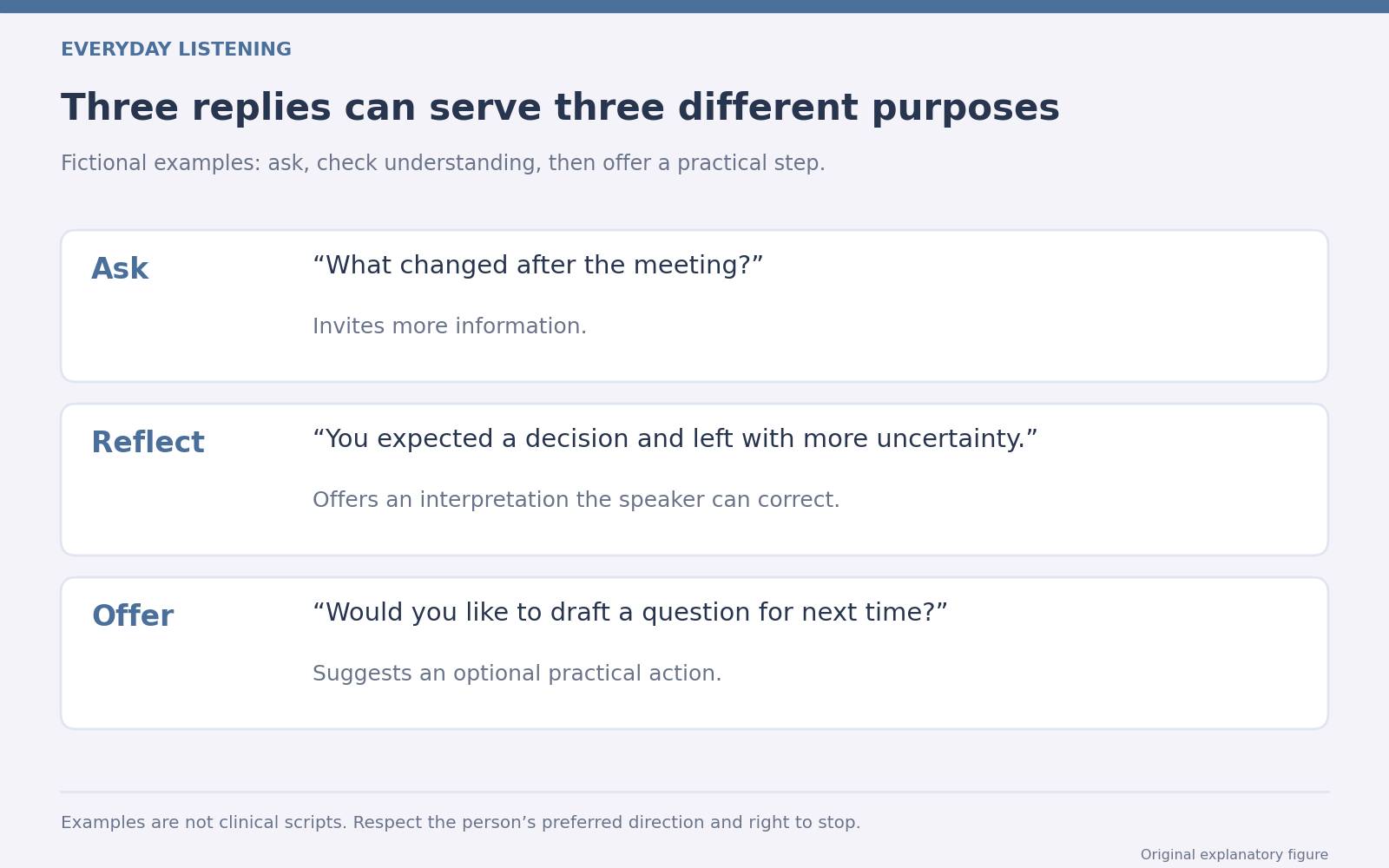
| “What changed after the meeting?” | Invites the person to add information. |
| “You were expecting a clear decision and left with more uncertainty.” | Reflects an interpretation that can be corrected. |
| “Would you like to draft a question for the next meeting?” | Offers a specific practical next step. |
The examples are fictional and deliberately ordinary. They are not scripts that must be repeated word for word. Their value lies in distinguishing functions: asking, checking understanding and offering action. A conversation can move among those functions without turning into a formal exercise.
Respect the right not to continue
Someone may decline to discuss a subject, choose a different listener or want to stop. Respect that choice. Curiosity is not permission to extract personal details. Do not promise secrecy that you cannot responsibly maintain, and do not turn private information into a story for a wider group.
Everyday support also has limits. If someone needs professional care, a friendly conversation is not a substitute. If there is immediate danger, seek urgent help appropriate to the situation. Recognizing those limits does not diminish the value of listening; it prevents an ordinary supportive role from becoming a claim of expertise.
End with a shared understanding
A short summary can check what was useful: what happened, what matters to the person, and whether any next step was agreed. Do not add a new action at the end as if it had already been accepted. If the outcome is simply that the person wanted to be heard, that can be a complete conversation.
This kind of attention connects social experience with questions about stress and wellbeing, but it does not prove that a particular conversation changed a hormone. The practical skill stands on its own. Biological explanations can be explored separately, with the same care about what was observed and what remains an interpretation.